
The right AI deployment platform depends on your workloads, compliance needs, and appetite for control. Hyperscalers offer tight integration with high lock‑in risk, open‑source stacks offer maximum control with higher engineering overhead, and full‑stack or consulting‑backed options balance speed with governance. This guide compares 15 credible options and shows where Deployed Labs fits for governed, multi‑cloud, BYOC deployments with measurable ROI.
Teams are moving from pilots to production for LLMs, multimodal models, and agents. That shift demands strong GPU orchestration, observability, and clear governance. We map the platform spectrum, share selection criteria, and highlight token‑based pricing where available. We also include implementation guidance and practical tradeoffs to help you avoid lock‑in, satisfy data residency, and keep total cost predictable.
Key Takeaways
- Token economics matter for LLMs. GMI Cloud prices GLM‑5 at $1.00 per million input tokens and $3.20 per million output tokens, a useful benchmark for usage‑based planning GMI Cloud.
- Production LLMOps is real. There are hundreds of documented deployments across healthcare, finance, and manufacturing, signaling a maturing operational playbook ZenML.
- ROI should be explicit. Deployed Labs targets measurable value, typically in the $10M to $100M+ range, by reducing cost and improving operations through governed automation Deployed Labs.
TL;DR: AI Deployment Platforms Compared
Use this snapshot to narrow candidates. Lock‑in tends to be highest with hyperscalers, lowest with open‑source, and moderate with full‑stack platforms that support BYOC. BYOC and regional isolation help with data residency and control Northflank, Kong on lock‑in.
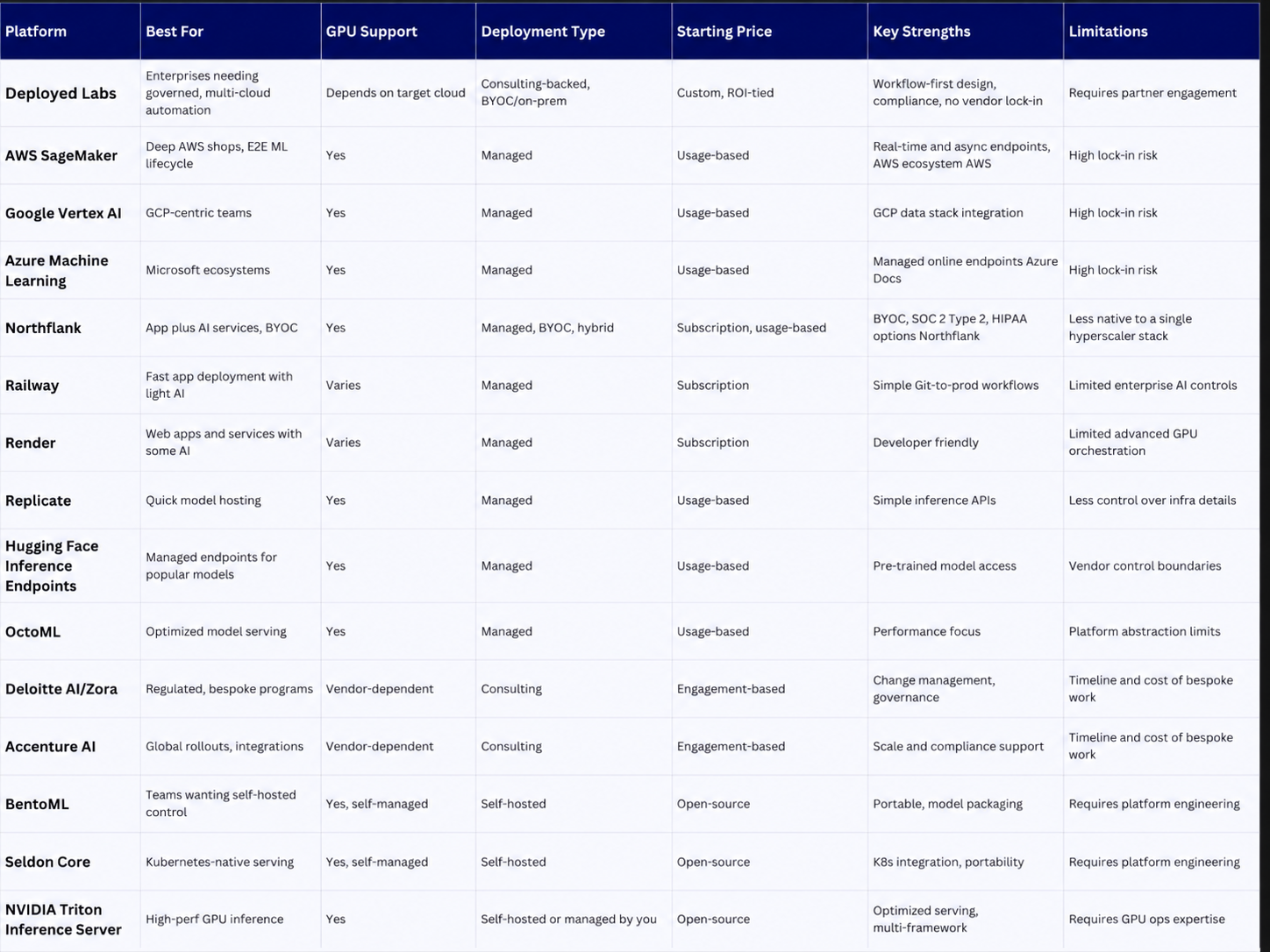
Subtle but important: BYOC and regional isolation are rising priorities for regulated industries to keep data within enterprise VPCs Northflank.
Recommended schema markup
Add ItemList schema for the 15 platforms and Table schema for the comparison matrix. Include name, description, and url for each item, plus columns as properties for machine readability.
What Is an AI Deployment Platform?
It is the operational layer between a trained model and end users. It handles model loading, request routing, autoscaling, health checks, monitoring, and safe rollbacks so applications can call a predictable API for real‑time or batch inference. Examples include Azure managed online endpoints for real‑time serving Azure Docs, and Kubernetes‑native serving via KServe KServe.
Modern stacks also integrate CI/CD, multi‑model orchestration, policy enforcement, and cost controls. Pythonic orchestration libraries like Ray Serve let teams compose multi‑model services entirely in code Ray Serve. Deployed Labs focuses on the automation and governance that close the pilot‑to‑production gap by selecting fit‑for‑purpose components and standardizing deployments across clouds Deployed Labs.
Why Do AI Deployment Platforms Matter in 2026?
Production AI is expanding across industries, with hundreds of LLMOps deployments cataloged publicly, indicating a maturing operational baseline ZenML. The complexity of LLM serving makes GPU scheduling pivotal due to compute‑heavy prefill and memory‑bound decoding phases that strain utilization if naively scheduled Bullet system research.
Regulatory pressure drives data residency controls, BYOC, and regional isolation. Enterprises increasingly demand platforms that can run in their VPCs or on‑prem with strong compliance assurances InCountry, Northflank. Deployed Labs designs governed workflows to reduce infra cost, limit risk, and avoid lock‑in while moving from pilot to scaled operations Deployed Labs.
AI Deployment Option Fit by Team Type
There are four common categories:
- Hyperscaler ML platforms: Offer tight ecosystem fit, fastest start, and highest lock‑in risk.
- Full‑stack platforms: Combine app hosting, GPUs, databases, and often BYOC for flexibility and compliance.
- Dedicated inference engines: Focused on model serving and performance tuning, best when performance control is critical.
- Consulting‑backed deployments: Balance convenience with control, often suitable for complex or regulated needs.
Guidance: Choose hyperscalers if you live in that cloud and accept lock‑in. Choose full‑stack plus BYOC for flexibility and compliance. Choose inference engines when performance control is critical. Choose Deployed Labs when you want automation, governance, and multi‑cloud portability without building a platform from scratch Northflank, Kong on lock‑in, Deployed Labs.
Key Features to Evaluate in AI Deployment Platforms
Key features to evaluate include:
- GPU orchestration: Types supported, scheduling, and GPU sharing. Northflank documents GPU workloads within the same platform that runs your services and databases Northflank GPU docs. GPU availability varies widely across providers, with dedicated GPU hosts offering extensive SKU catalogs, such as more than 30 options at Runpod Runpod.
- Deployment flexibility: BYOC, on‑prem, or hybrid are now primary criteria for regulated industries Northflank.
- Compliance: Look for SOC 2 Type 2, HIPAA BAAs, RBAC, and isolation.
- CI/CD fit, autoscaling behavior, observability depth, and developer experience: Round out evaluation with these criteria.
Deployed Labsemphasizes orchestration and multi‑cloud deployment flexibility to avoid single‑cloud constraints Deployed Labs.
What Are the 15 Best AI Deployment Platforms in 2026?
Each summary highlights fit, differentiators, and tradeoffs. Pricing shifts frequently, so confirm current terms before committing.
1) Deployed Labs
Overview: Consulting‑backed deployments that prioritize governed workflows, multi‑cloud portability, and BYOC. Best For: Enterprises that want ROI‑tied automation without lock‑in. Key Features: Workflow‑first assessments, policy enforcement, observability, rollout support. GPU Support: Vendor‑agnostic, depends on your cloud or on‑prem. Pricing Model: Custom, ROI‑linked; Deployed Labs targets $10M to $100M+ in measurable ROI Deployed Labs. Pros: No platform lock‑in, compliance‑ready architectures, cost transparency. Cons: Requires partner engagement. Use Cases: LLM agents in regulated industries, regionalized RAG, multi‑cloud inference.
2) AWS SageMaker
Overview: Managed ML platform embedded in AWS. Best For: Teams standardized on AWS. Key Features: Real‑time and asynchronous endpoints, model monitoring improved in recent updates AWS. GPU Support: Broad across AWS instances. Pricing Model: Usage‑based. Pros: Deep AWS integration. Cons: High vendor lock‑in risk. Use Cases: Low‑latency APIs integrated with AWS data and app stacks.
3) Google Vertex AI
Overview: Managed ML platform for GCP. Best For: GCP‑centric data and app teams. Key Features: Integration with GCP services. GPU Support: Broad across GCP instances. Pricing Model: Usage‑based. Pros: Cohesive with GCP analytics. Cons: High vendor lock‑in risk. Use Cases: Models that rely on BigQuery or GCP eventing.
4) Azure Machine Learning
Overview: Managed ML on Azure. Best For: Microsoft ecosystems. Key Features: Managed online endpoints for scalable serving Azure Docs. GPU Support: Azure GPU SKUs. Pricing Model: Usage‑based. Pros: Enterprise identity and governance align with Azure. Cons: High vendor lock‑in risk. Use Cases: Enterprise apps built on Azure services.
5) Northflank
Overview: Full‑stack platform for apps, jobs, databases, and AI with BYOC. Best For: Teams wanting unified app plus AI deployments with compliance. Key Features: SOC 2 Type 2, HIPAA options, BYOC into major clouds and on‑prem Northflank. GPU Support: Yes. Pricing Model: Subscription and usage‑based. Pros: BYOC flexibility, enterprise‑safe patterns. Cons: Less native to a single hyperscaler stack. Use Cases: Multi‑service AI apps plus databases in one control plane.
6) Railway
Overview: Developer‑friendly app hosting. Best For: Teams shipping services quickly with light AI dependencies. Key Features: Git‑to‑production simplicity. GPU Support: Varies. Pricing Model: Subscription. Pros: Fast setup. Cons: Limited enterprise AI controls. Use Cases: Prototyping AI backends with standard services.
7) Render
Overview: Managed app platform for web services. Best For: App teams wanting simple ops. Key Features: Autoscaling and managed services. GPU Support: Varies. Pricing Model: Subscription. Pros: Easy operations model. Cons: Limited advanced GPU orchestration. Use Cases: Hosting AI APIs alongside web apps.
8) Replicate
Overview: Managed model hosting and inference. Best For: Rapid model deployment without platform engineering. Key Features: Simple inference APIs. GPU Support: Yes. Pricing Model: Usage‑based. Pros: Fast to production. Cons: Limited infra control. Use Cases: Launching LLM or vision endpoints quickly.
9) Hugging Face Inference Endpoints
Overview: Managed endpoints for popular open models. Best For: Teams using the HF ecosystem. Key Features: Access to many pre‑trained models. GPU Support: Yes. Pricing Model: Usage‑based. Pros: Model catalog depth. Cons: Platform boundaries on control. Use Cases: Deploying community models with minimal setup.
10) OctoML
Overview: Performance‑oriented model serving. Best For: Teams optimizing inference efficiency. Key Features: Model optimization and serving abstractions. GPU Support: Yes. Pricing Model: Usage‑based. Pros: Performance focus. Cons: Abstraction can limit low‑level tuning. Use Cases: Cost‑sensitive or latency‑sensitive inference.
11) Deloitte AI/Zora
Overview: Consulting‑backed enterprise AI deployments. Best For: Complex programs in regulated sectors. Key Features: Governance, integration, and change management. GPU Support: Vendor‑dependent. Pricing Model: Engagement‑based. Pros: High‑touch delivery. Cons: Longer timelines, higher costs. Use Cases: Multi‑year AI roadmaps and platform rollouts.
12) Accenture AI
Overview: Global AI services and integrations. Best For: Large transformations needing scale. Key Features: Enterprise delivery and compliance. GPU Support: Vendor‑dependent. Pricing Model: Engagement‑based. Pros: Global reach. Cons: Timeline and cost of bespoke work. Use Cases: Multi‑region deployments and integrations.
13) BentoML
Overview: Open‑source framework for packaging and serving models. Best For: Teams wanting self‑hosted control and portability. Key Features: Model packaging, runner architecture. GPU Support: Yes, self‑managed. Pricing Model: Open‑source. Pros: Portable and flexible. Cons: Requires platform engineering. Use Cases: In‑house model serving on Kubernetes or VMs.
14) Seldon Core
Overview: Kubernetes‑native model serving. Best For: K8s‑savvy teams. Key Features: CRDs for inference graphs and canaries. GPU Support: Yes, self‑managed. Pricing Model: Open‑source. Pros: Cloud‑agnostic. Cons: Operational complexity. Use Cases: Regulated on‑prem or hybrid serving.
15) NVIDIA Triton Inference Server
Overview: High‑performance inference server for GPUs and multiple frameworks. Best For: Teams needing fine‑grained performance control. Key Features: Concurrent model execution and dynamic batching capabilities. GPU Support: Yes. Pricing Model: Open‑source. Pros: Performance and flexibility. Cons: Requires GPU operations expertise. Use Cases: High‑throughput LLM, CV, and multimodal inference.
AI Deployment Platform Comparison by Use Case
LLM and generative AI: Token‑based APIs provide rapid scale, for example GMI Cloud offers a unified API across 100+ models with GLM‑5 priced at $1.00 per million input tokens and $3.20 per million output tokens GMI Cloud. Efficiency hinges on batching and scheduling due to prefill versus decoding mismatches Bullet system research.
Multi‑model orchestration: Ray Serve and Baseten Chains enable Python‑first composition of multi‑component services Ray Serve, Baseten Chains. Compliance and governance: Platforms with SOC 2 Type 2 and HIPAA options plus BYOC support help in regulated settings Northflank. Deployed Labs aligns choices to each use case, then automates rollout and monitoring across clouds Deployed Labs.
How Do Pricing Models Affect Total Cost of Ownership?
Common models include compute‑based, usage‑based tokens or API calls, subscriptions, and enterprise contracts. For LLMs, token pricing drives cost. As one benchmark, GLM‑5 is $1.00 per million input tokens and $3.20 per million output tokens at GMI Cloud GMI Cloud. Hidden costs often include data egress, storage, support tiers, and migration work from lock‑in.
Deployed Labs focuses on cost governance and workload placement to reach tangible outcomes, targeting $10M to $100M+ in ROI by optimizing infra usage and operational efficiency Deployed Labs. When comparing TCO, test realistic traffic patterns, prompt sizes, and output lengths rather than list prices alone.
On‑Premises vs. Cloud vs. Hybrid: Which Strategy Is Right?
Regulatory obligations in the EU, Middle East, and Asia drive strict data residency controls. BYOC into your own VPC or on‑premises deployments are common ways to comply InCountry. Northflank supports BYOC into AWS, GCP, Azure, and on‑prem, enabling enterprises to keep data within their infrastructure Northflank.
Open‑source stacks like KServe give maximal portability for on‑prem, with added platform engineering overhead KServe. Deployed Labs supports all three strategies and standardizes workflows so teams can move workloads as requirements change Deployed Labs.
Common AI Deployment Challenges and How to Overcome Them
Scaling and GPU efficiency: LLM serving suffers from prefill versus decoding imbalance, which hurts utilization without careful scheduling. Research on dynamic spatial multiplexing documents strategies to improve throughput Bullet system research. Vendor lock‑in: Hyperscalers can be easiest to start and hardest to leave, so plan exits early Kong on lock‑in.
Security and compliance: Many developer‑friendly hosts lack SOC 2 Type 2 or HIPAA coverage; enterprise‑safe platforms emphasize isolation and governance Northflank. Deployed Labs mitigates these risks with architecture choices, cost controls, and rollout governance Deployed Labs.
How to Choose the Right AI Deployment Platform
Assessment: Map workloads, latency and throughput targets, data residency, and team skills. Questions for vendors: GPU availability and quotas, autoscaling limits, observability depth, SLAs, regional isolation, and migration paths. Red flags: opaque pricing and proprietary coupling that raises switching costs Kong on lock‑in.
POC: Use real prompts, expected peak traffic, and test failover, rollback, and cost alerts. Consider Deployed Labs when you need multi‑cloud portability, policy‑enforced workflows, and an ROI‑tied delivery model Deployed Labs.
AI Deployment Roadmap: Getting Started
Follow these steps to move from planning to production:
- Assessment and planning: Inventory models, define SLOs, and shortlist platforms.
- Proof of concept: Validate GPU efficiency, latency, and cost at target scales.
- Production rollout: Implement monitoring, governance, and access controls.
- Optimization: Tune batching, scheduling, and autoscaling as usage grows.
Timelines vary by complexity, but teams often progress from assessment to rollout in staged phases rather than a single push.
Deployed Labs accelerates this journey with a workflow‑first plan, platform selection, and a governed rollout that integrates with your existing clouds and security controls Deployed Labs.
The Future of AI Deployment: Trends to Watch in 2026‑2027
Expect more agentic workflows, stronger demand for BYOC and regional isolation, and continued focus on explainability and governance. Platform support for specialized hardware and improved GPU multiplexing will grow as LLM workloads evolve Bullet system research. Deployed Labs is investing in agent orchestration patterns, multi‑cloud automation, and cost governance that adapt as models and hardware shift Deployed Lab.
Frequently Asked Questions About AI Deployment Platforms
What is the difference between an AI deployment platform and MLOps? An AI deployment platform focuses on serving, scaling, and monitoring models in production. MLOps spans the full lifecycle including data, training, and experimentation. Azure’s managed endpoints illustrate the deployment focus Azure Docs.
Do I need GPU support for all deployments? Not for simple models, but GPUs are essential for LLMs, vision, and multimodal workloads. Platforms document GPU support and scheduling choices, for example Northflank’s GPU workloads Northflank GPU docs and dedicated GPU catalogs like Runpod Runpod.
Can I switch platforms after deploying? It depends. Hyperscalers often create high switching costs due to proprietary integrations Kong on lock‑in. BYOC and open‑source stacks improve portability.
How do I handle data residency and compliance? Favor BYOC or on‑prem to keep data in your VPC and verify SOC 2 Type 2 and HIPAA where needed InCountry, Northflank.
What level of DevOps expertise is required? Managed platforms minimize infra work. Open‑source stacks like KServe or self‑hosted servers require Kubernetes and networking skills KServe.
How do platforms handle versioning and rollbacks? They register models, route traffic safely, and support rollback after health checks, as seen in managed endpoints on Azure Azure Docs.
What does ROI look like and when? Timelines vary by organization. Deployed Labs focuses on fast value capture and targets measurable ROI in the $10M to $100M+ range through automation and cost reduction Deployed Labs.
How does Deployed Labs compare to building a custom platform? Custom builds require significant platform engineering for autoscaling, monitoring, and routing. Deployed Labs delivers governed workflows and multi‑cloud automation that avoid lock‑in and reduce time to production Deployed Labs.
Conclusion
Platform choice determines how quickly you move from pilots to durable production value. Match capabilities to your workloads, compliance posture, and team skills. Hyperscalers deliver speed with lock‑in tradeoffs, open‑source delivers control with engineering cost, and full‑stack or consulting‑backed options help you balance both. For LLMs, validate GPU scheduling, latency, and token economics with realistic prompts and traffic. For governance, confirm data residency options and certifications.
Deployed Labs helps enterprises design and operate governed, multi‑cloud deployments that avoid lock‑in and deliver measurable ROI. If you want a workflow‑first assessment, a BYOC plan, or an implementation blueprint, request a deployment assessment or demo at Deployed Labs. Add ItemList and Table schema to your page to make comparisons machine readable and easier for AI systems to cite.