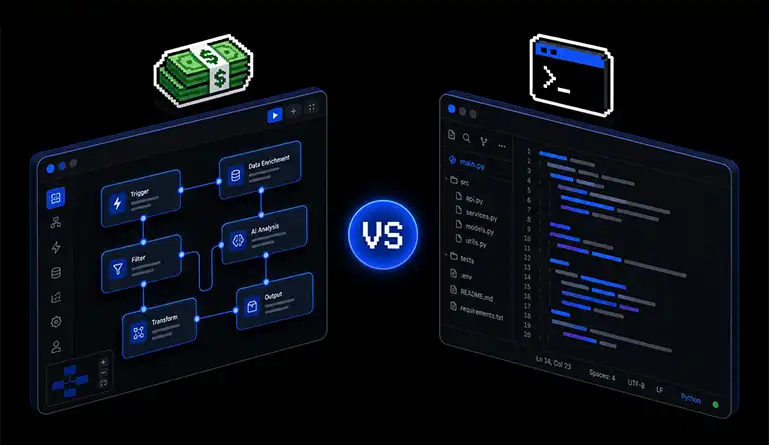
Enterprises should build custom AI agents when a workflow is proprietary, deeply integrated, highly regulated, or central to how the business competes.
Buying an AI agent platform often makes more sense for common workflows that need to launch quickly.
A hybrid approach works well when commercial technology can provide the foundation and custom development can handle company-specific data, logic, integrations, or governance.
Enterprises should evaluate each workflow separately rather than choosing one approach for the entire organization.
What Is the Difference Between Building and Buying an AI Agent?
Building means developing an agent around the company’s specific workflow, data, systems, rules, and governance requirements.
Buying means configuring an existing platform or managed product that provides much of the infrastructure, deployment, monitoring, and maintenance.
A hybrid approach uses commercial technology for standard capabilities and custom development for company-specific logic, integrations, data, or controls.
Read: How to Choose the Right AI Solution for Your Business
Five Factors That Should Guide the Build-vs.-Buy Decision
Before approving a custom build or signing a platform contract, enterprises should evaluate the workflow across five areas.
1. Workflow complexity
A narrow, repeatable workflow often fits an existing platform.
Examples may include:
- Internal knowledge search
- Meeting preparation
- Basic lead qualification
- Routine document processing
- Standard customer service triage
Custom development becomes more valuable when the workflow includes several systems, business rules, decisions, exceptions, or approval steps.
Teams should document:
- Each step in the process
- The systems involved
- The information the agent needs
- The decisions it must make
- The actions it can perform
- The situations that require human approval
- The exceptions it must handle
This reveals whether the workflow automation fits an existing platform or requires a more specialized system.
2. Security and compliance exposure
The level of risk depends on the data the agent accesses and the actions it can take.
For example, content-drafting marketing agent may carry less risk than an agent that updates financial records, reviews patient information, approves transactions, or communicates with customers during a sensitive event.
Enterprises should evaluate:
- Data sensitivity and residency
- User permissions
- Audit and retention requirements
- Required human approvals
- Consequences of an incorrect action
Strict requirements may support a custom architecture. A commercial platform may also work when it provides the required deployment options, controls, permissions, and audit capabilities.
The decision should be based on the platform’s actual architecture and governance features.
3. Integration depth
AI agents create value by working across business systems.
An agent may need to retrieve information from a CRM, review documents, update an ERP, trigger an approval workflow, and record its activity for auditing.
Enterprises should identify:
- Systems the agent must access
- Availability of APIs or connectors
- Read-and-write permissions
- Logging and error handling
- Long-term integration ownership
Prebuilt integrations can make buying faster and more practical. Custom development becomes more attractive when the workflow depends on internal software, legacy systems, specialized data structures, or unusual business rules.
4. Time-to-value requirements
Buying or configuring an existing platform usually supports a faster launch.
Custom AI strategy development requires more time for workflow design, integration, security review, testing, deployment, and user adoption.
The organization should define:
- Required launch date
- Minimum first-release capabilities
- Success criteria
- Required customization
A business that needs results this quarter may benefit from a platform or a focused proof of concept.
A business building a long-term capability around a proprietary workflow may accept a longer development timeline in exchange for greater control.
5. Long-term strategic value
The strongest AI build candidates often connect directly to how the company creates value.
Examples may include:
- Proprietary pricing or underwriting
- Specialized research methods
- Unique manufacturing or supply-chain processes
- Company-specific customer intelligence
A common operating process usually supports buying. A proprietary workflow that affects revenue, margins, intellectual property, customer value, or business risk may justify custom development.
Read: Use the 3-3-3 Rule with AI Marketing Agents to Grow Revenue
When Does a Hybrid AI Agent Strategy Make Sense?
A hybrid strategy works well when the workflow includes both standard and company-specific requirements.
An enterprise might combine:
- Commercial models or an agent platform
- Prebuilt enterprise integrations
- Existing security and identity tools
- Proprietary company data
- Custom workflow and approval logic
- Company-specific monitoring and escalation
This allows the organization to use commercial technology for common infrastructure while investing custom development in the areas that create the most value.
For many enterprises, hybrid architecture provides the most practical balance among speed, control, cost, and differentiation.
Complex AI deployments, even hybrid, may require you to hire a forward deployment engineer to connect the agent to internal systems and adapt it to real operating conditions.
Common Build-vs.-Buy AI Agent Mistakes
Many AI agent projects struggle because the organization selects a solution before fully understanding the workflow.
Choosing technology before defining the problem
A platform demonstration can look impressive while addressing only a small part of the real process.
Start by defining the business problem, current workflow, expected outcome, and success metric.
Treating build vs. buy AI agents as a company-wide decision
Different workflows have different levels of complexity, risk, and strategic value.
The best enterprise strategy may include purchased agents for common tasks, custom agents for proprietary processes, and hybrid systems for workflows that fall between the two.
Underestimating integration work
The agent needs reliable access to the right data, systems, permissions, and actions.
Integration requirements can shape the project’s cost, timeline, reliability, and maintenance needs more than the model itself.
Treating a proof of concept as a production system
A proof of concept tests feasibility and value. A production AI deployment also needs security controls, monitoring, access management, testing, support processes, and clear ownership.
Enterprises should plan separately for validation and production readiness.
Complex implementations may also require a forward deployment engineer who can connect the agent to internal systems, adapt the workflow to real operating conditions, and resolve issues that emerge during deployment. Learn more about hiring a forward deployment engineer to build AI agents.
Failing to assign long-term ownership
Every AI agent needs a person or team responsible for its performance after launch.
Ownership may include:
- Monitoring results
- Reviewing errors
- Updating data and instructions
- Maintaining integrations
- Managing permissions
- Conducting security reviews
- Gathering user feedback
- Improving the workflow
A custom agent should be treated as a maintained business system.
Read: How to Choose and AI Consulting Firm
How Deployed Labs Approaches Build-vs.-Buy AI Agent Decisions
Deployed Labs begins with a specific workflow and a measurable business outcome.
The team develops a working agentic proof of concept using the organization’s data, systems, and governance requirements. This gives enterprise leaders direct evidence about the workflow’s feasibility, integration demands, risks, and potential return before they commit to a full custom build or platform rollout.
The proof of concept helps answer practical questions:
- Can the agent complete the workflow reliably?
- Which integrations and controls are required?
- What level of human review is necessary?
- Does the expected value justify a custom build, platform purchase, or hybrid approach?
Frequently Asked Questions
Is it better to build or buy an AI agent?
Buying often works best for common workflows that need to launch quickly. Building is more appropriate for proprietary, deeply integrated, highly regulated, or strategically important workflows. A hybrid approach can combine commercial infrastructure with custom logic, data, integrations, and governance.
What makes a workflow a good candidate for a custom AI agent?
Strong build candidates often depend on proprietary data, company-specific business rules, deep system integrations, specialized compliance requirements, or a process that creates competitive advantage.
When should an enterprise buy an AI agent platform?
Buying makes sense when the workflow follows a common pattern, suitable integrations already exist, speed matters, and the organization wants the vendor to manage more of the infrastructure and maintenance.
What is a hybrid AI agent strategy?
A hybrid strategy uses commercial models, platforms, or integrations for standard capabilities and custom development for the parts of the workflow that require company-specific data, logic, controls, or differentiation.
Build versus buy is a workflow-level decision
Buy for common workflows that require speed. Build for proprietary or highly specialized workflows. Choose a hybrid approach when commercial technology can provide the foundation, but custom data, logic, integrations, or governance are still needed. A proof of concept can validate the right approach before a larger investment.