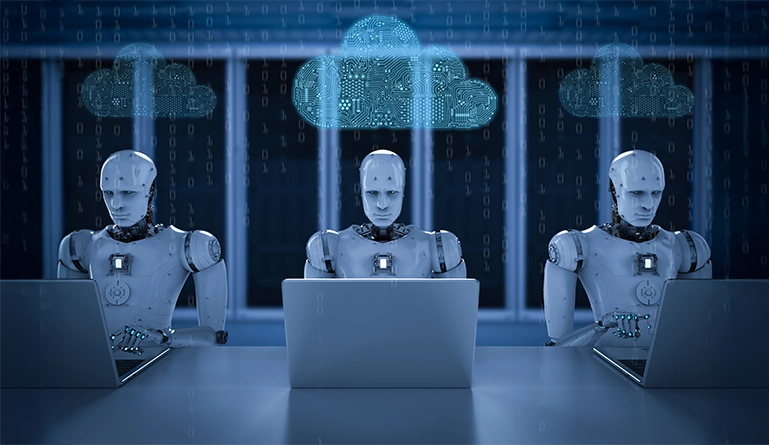

Enterprise automation programs now weigh two distinct models against each other. One relies on scripts, rule engines, and orchestration platforms refined across three decades of IT operations. The other combines AI decision-making with sensors, robotics, and connected equipment, extending automation into warehouses, plants, clinics, and facilities where digital instructions alone fall short. Both models solve real problems. Neither replaces the other outright.
This guide defines tangible agents and traditional IT automation, compares the two across deployment scope, adaptability, integration demands, and operational fit, and explains the agent taxonomies architects reference when mapping technology to business goals.
What Are Tangible Agents?
Tangible agents are automation systems combining AI decision-making with the ability to sense and act on physical environments. Where a purely digital agent reads data and writes data, a tangible agent reads sensor input and produces physical change: a robotic arm repositions a component, an autonomous mobile robot moves a pallet, a building management system adjusts airflow after detecting a shift in occupancy.
The defining property is a closed loop between perception and action in the physical world. A tangible agent observes conditions through cameras, lidar, temperature probes, RFID readers, or vibration sensors. Those observations are interpreted against a goal. An action follows, and the result of the action becomes the next observation. Each cycle updates the agent's internal model of the environment, which allows behavior to improve without a rewritten rulebook.
Three properties separate tangible agents from digital-only automation:
- Perception. Input arrives as unstructured signals from the physical environment rather than as clean records from an API.
- Adaptation. Decision policies are learned or inferred, so the agent handles conditions absent from the original specification.
- Consequence. Actions change physical state, which introduces safety, wear, and recovery considerations absent from software workflows.
Typical enterprise deployments include automated warehouse fulfillment, quality inspection on manufacturing lines, predictive maintenance triggered by acoustic and thermal readings, AI-driven facility and energy management, and field asset inspection using drones or crawlers.
What Is Traditional IT Automation?
Traditional IT automation uses software scripts, rule engines, and orchestration platforms to execute repetitive operations across digital systems. An orchestration platform coordinates multi-step workflows across servers, applications, and services, handling sequencing, dependencies, and error branches defined in advance by an engineer.
Common categories include:
- Configuration management. Tools such as Ansible, Puppet, or Chef enforce a declared server state across a fleet.
- Job scheduling and batch processing. Workloads run on fixed schedules or in response to defined system events.
- Backup and recovery. Snapshots, replication, and restore routines run without human initiation.
- Network monitoring and remediation. Scripts detect threshold breaches and apply predefined corrections.
- CI/CD pipelines. Build, test, and deployment stages execute on every code change.
- Robotic process automation, or RPA. Software bots replicate keystrokes and clicks across applications lacking usable APIs, despite the name, RPA operates entirely in software.
The model's strength is determinism. Given identical input, a script produces identical output every time, which supports audit trails, compliance evidence, and predictable capacity planning. Marginal cost per execution approaches zero, and scaling means adding compute rather than hardware on a plant floor.
The model's limit is brittleness. Rule-based workflows fail when inputs deviate from the anticipated pattern, and each new exception requires engineering time. Traditional automation also has no perception of physical state. A backup script knows a database is unreachable, though nothing about the failed cooling unit above the rack.
Core Comparison: Tangible Agents vs Traditional IT Automation
Tangible agents differ from traditional IT automation in four respects: they operate across physical and digital environments rather than software alone, they adapt through learning rather than following static rules, they require sensor and robotics integration rather than API compatibility, and they fit dynamic conditions rather than standardized repeatable processes.
Deployment scope
Traditional automation lives inside the software estate. Targets are servers, containers, databases, network devices, and SaaS applications, all reachable through APIs, agents, or command interfaces. Tangible agents extend across both domains. A warehouse agent updates a warehouse management system and moves inventory, so the deployment covers enterprise software, edge compute, and physical equipment with maintenance schedules and safety certifications.
Flexibility and adaptation
Rule-based automation executes the logic written into the workflow. Behavior changes when an engineer changes the code. Tangible agents adjust policies against observed outcomes, which suits environments where conditions vary between runs: lighting shifts, packages arrive in unexpected orientations, equipment wears unevenly. The tradeoff is predictability. Adaptive behavior demands monitoring, guardrails, and defined operating envelopes.
Integration requirements
Traditional automation integrates through software interfaces, and the technical work concentrates on credentials, permissions, and API contracts. Tangible agents require additional layers: sensor networks, edge compute close to the equipment, industrial protocols such as OPC UA or Modbus, safety systems, and often physical modification of the workspace. Integration timelines run longer, and cross-functional ownership between IT, operations, and facilities becomes a project prerequisite.
Use case fit
Traditional automation suits high-volume, well-defined, digital-only processes with stable inputs: provisioning, patching, reporting, backups, identity lifecycle management. Tangible agents suit variable physical work with meaningful labor or downtime cost: material handling, inspection, maintenance, and environmental control. Attempting to script physical variability produces fragile systems, and applying learned policies to a nightly backup job adds cost without benefit.
Failure modes and oversight
A failed script produces an error log and a retry. A failed tangible agent might damage inventory, halt a production line, or create a safety incident. Governance requirements differ accordingly: physical deployments need fail-safe behavior, human override, incident response procedures, and periodic validation of learned behavior against expected performance.
What are the 7 types of AI agents?
The seven types of AI agents are simple reflex agents, model-based reflex agents, goal-based agents, utility-based agents, learning agents, physical agents including robots, and multi-agent systems. Each type differs in decision-making complexity, learning capability, and depth of interaction with the environment.
- Simple reflex agents. Action follows current perception through condition-action rules, with no memory of past states. A thermostat responding to a temperature reading is the standard example.
- Model-based reflex agents. An internal representation of the world lets the agent account for conditions outside immediate perception, supporting decisions in partially observable environments.
- Goal-based agents. Actions are selected by evaluating which options advance a defined goal state, which allows planning across multiple steps.
- Utility-based agents. Outcomes are scored against a utility function, so the agent chooses between competing goals or trades speed against cost.
- Learning agents. Performance improves through feedback, with a learning component adjusting the decision policy based on results.
- Physical agents. Robotics, autonomous vehicles, and sensor-equipped machines act on the physical environment, and this category maps most directly to tangible agents in an enterprise setting.
- Multi-agent systems. Multiple agents coordinate, negotiate, or compete toward shared or conflicting objectives, as in a fleet of mobile robots allocating tasks across a facility.
What are the four types of agents?
The four core types of agents are simple reflex agents, model-based reflex agents, goal-based agents, and utility-based agents. The classification, drawn from foundational AI literature, orders agents by decision-making strategy and by how much environmental complexity each type handles.
- Simple reflex agents act on current perception alone.
- Model-based reflex agents maintain internal state to handle partial observability.
- Goal-based agents evaluate actions against a target condition.
- Utility-based agents weigh outcomes on a preference scale when several goals compete.
Learning capability sits across all four rather than beside them: any of the four architectures gains a learning component. Physical embodiment is likewise orthogonal, since a robot might run simple reflex logic or a utility-based policy depending on the task.
Enterprise Use Cases and Decision Criteria
Selection follows from the environment and the outcome, not from the technology label.
Tangible agents earn their cost where physical variability drives expense. Logistics operations with fluctuating volumes, manufacturing lines with quality tolerances checked visually, energy-intensive facilities with occupancy patterns shifting week to week, and asset-heavy infrastructure requiring inspection in hazardous conditions all show measurable returns.
Traditional IT automation remains the correct choice for digital-only work with stable definitions. Provisioning environments, rotating credentials, enforcing configuration baselines, running regression suites, and generating compliance reports need reliability and auditability rather than adaptability.
Five questions narrow the decision:
- Does the process require sensing or changing physical state? A negative answer points to traditional automation.
- How much do inputs vary between executions? High variance favors adaptive agents, low variance favors deterministic rules.
- What is the cost of an incorrect action? Physical consequences raise the governance burden and the required validation effort.
- Which teams own the outcome? Deployments spanning IT, operations, and facilities need a defined owner before procurement begins.
- What evidence is needed for audit? Regulated processes benefit from the traceability of rule-based execution, and learned behavior requires logging designed for review.
Most enterprises run both. A fulfillment center pairs mobile robots on the floor with orchestration scripts managing the warehouse management system, inventory sync, and reporting. The interface between the two layers, where physical events enter systems of record, is where integration effort concentrates and where value accrues.
CT Labs advises mapping operational goals and environmental constraints to agent type before evaluating vendors, since a shortlist built around capability descriptions rather than deployment reality tends to surface products misaligned with the actual work.
Summary Table: Tangible Agents vs Traditional IT Automation
DimensionTangible AgentsTraditional IT AutomationDeployment contextPhysical and digitalDigital onlyLearning and adaptationAI-driven, policy improves with feedbackRule-governed, changes require engineeringIntegrationSensors, robotics, IoT, edge compute, industrial protocolsSoftware APIs, agents, command interfacesTypical use casesWarehouse robotics, quality inspection, smart facilities, predictive maintenanceProvisioning, patching, backups, monitoring, CI/CDFailure impactPhysical damage, safety exposure, line stoppageFailed job, error log, retryTime to valueMonths, gated by hardware and safety validationDays to weeksAuditabilityRequires purpose-built logging of learned behaviorDeterministic execution logsScaling costHardware plus integration per siteCompute, near-zero marginal cost
Enterprises building automation roadmaps benefit from treating the two models as complementary layers with different governance needs, different owners, and different measures of success.