
The gap between AI use and AI trust
Only 1 in 4 business professionals say their company has a clear process to verify AI output. The figure comes from The Cognition Index, a study by WSJ Intelligence and Philip Morris International published in 2026.
The survey covered 2,507 professionals in the U.S., U.K., Italy, South Africa and Brazil between February 26 and April 13, 2026. 35% of respondents hold C-suite roles. Their companies average $4.7B in annual revenue.
The study shows teams using AI every week while doubting what AI produces. For companies scaling AI, the constraint is the people who run, check and own the output.
Teams use AI more than they trust the output
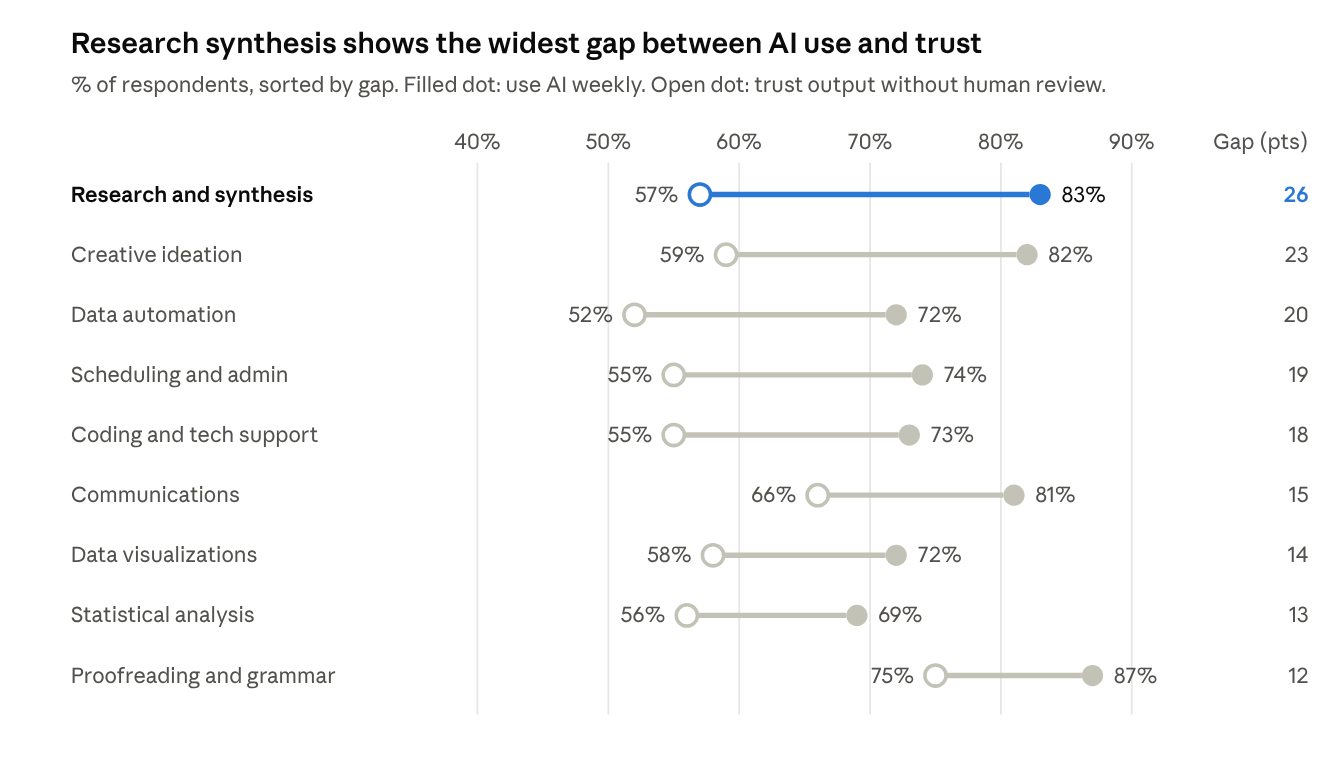
The Cognition Index, WSJ Intelligence and PMI, 2026 · Figure 8 · n = 2,507
The gap appears in all 9 tasks measured. For research and information synthesis, 83% of respondents use AI tools each week, and 57% trust the output without a human review.
AI confidence sits at the top
Executives trust AI output more than the people who work with AI output each day. C-suite respondents are twice as likely as entry-level staff to rate their AI skills as advanced or expert. 12% of the C-suite call themselves AI experts, against 3% of entry-level staff and mid-level managers.
Trust follows the same split. Senior leaders trust AI-generated code 14 points more than entry-level staff, and AI scheduling output 14 points more. For creative ideas the gap is 12 points.
Views on verification split too. 30% of C-suite respondents say their company has a clear fact-checking protocol for AI. Among mid-level staff the figure is 17%, and among entry-level staff 19%.
What the gap means for AI agents in production
4 findings point to how agents need to be built.
- Checking is inconsistent. 49% of respondents say AI output gets reviewed often. 28% say sometimes, 16% rarely and 7% never. An agent without built-in evaluation depends on whatever habit its user has.
- People want the final call. 62% say human intuition should outrank AI on creative decisions. 50% say the same for strategic and predictive decisions such as market analysis. Only 12% and 20% would let AI take precedence.
- Accountability stays with people. Most respondents say they are responsible for the quality of AI-supported work. 42% of C-suite respondents say reinforcing accountability for AI-assisted work is a priority.
- Expectations are high. About 7 in 10 respondents expect AI to improve the quality of business decisions within 5 years.
Leaders expect results from AI. Their teams want proof the results hold up. Agents built with evaluation, audit trails and human review answer both.
How Deployed Labs builds for trust
Deployed Labs builds a working agent before a client commits to full deployment, and ties every agent to a business metric. Each stage of the delivery model addresses a gap in the Cognition Index.
- Agentic ROI Discovery: 4 weeks to map the highest-cost workflows, rank them by economic impact and agent readiness, and size the return.
- ROI Agent Proof of Concept: a working agent in the client's environment, with evaluation controls, governance guardrails and human-in-the-loop oversight.
- Production Buildout and Scale: deployment with change management, observability and ROI tracked milestone by milestone.
Governance ships as standard in every agent: benchmarks, regression testing, role-based access controls, audit trails and observability dashboards. These controls supply the verification step only 1 in 4 respondents say their company has today.
One example: a national insurance brokerage with $1B in revenue deployed contract analysis agents inside its sales and legal workflows. Contract review coverage rose from under 50% to over 90%, with human judgment kept in the process. Projected incremental revenue is $75M to $125M a year.
Book a consultation to find the workflow in your company where an agent pays back first.